
The digital twin that simulates, plans, and certifies.
Address-level. Audit-trailed. AER-aligned. AgenticGrid takes a single distribution area and runs every analysis a network planner, regulator, or board needs — from voltage compliance to AI-driven cost-benefit — and explains every step.
Reports
Eleven report types, one model.
Generated automatically for every sub-scenario you run. No manual stitching, no template wrangling.
Scenario library
12 scenarios × 61 sub-scenarios — and the next one is a paragraph away.
The Broken Hill reference twin ships with 12 parameterised demand-management scenarios across 61 seasonal and probability-of-exceedance sub-scenarios — solar penetration ramp, behind-the-meter and community batteries, EV charging, electrification, resilience, demand management, tariff impact, weather envelopes. A new scenario is a natural-language ask away.
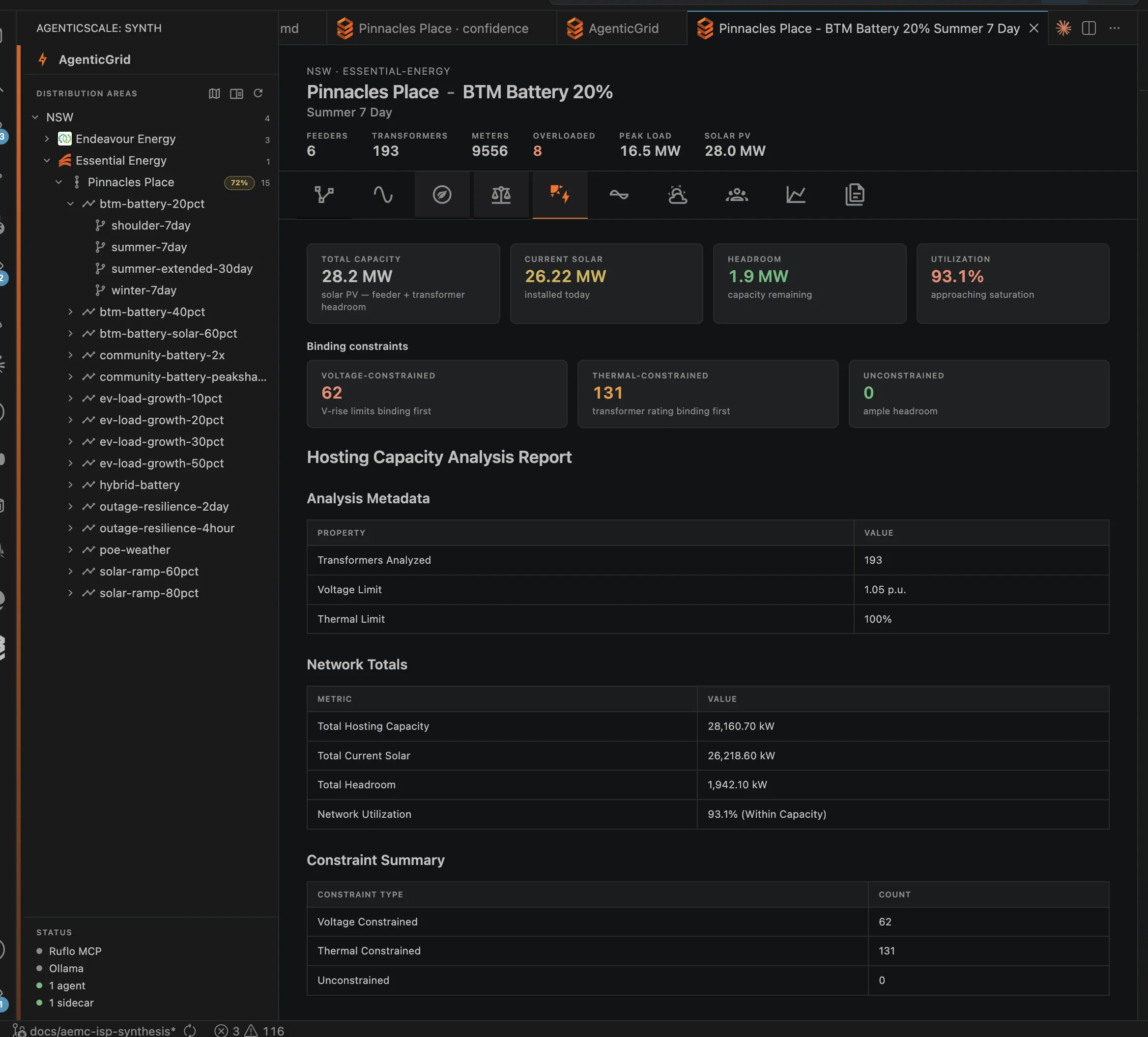
Solar is the binding constraint today
Broken Hill's network is already close to its solar-hosting limit. Push solar penetration to 80% and the breach is emphatic — hosting-capacity utilisation 178.9%, reverse power flow 40.3 MW (over 2.5× the peak import the network was built to carry). Unambiguous trigger for augmentation or active management.
- Hosting utilisation
- 178.9%
- Reverse power flow
- 40.3 MW
- Baseline (as-built)
- 94.2%
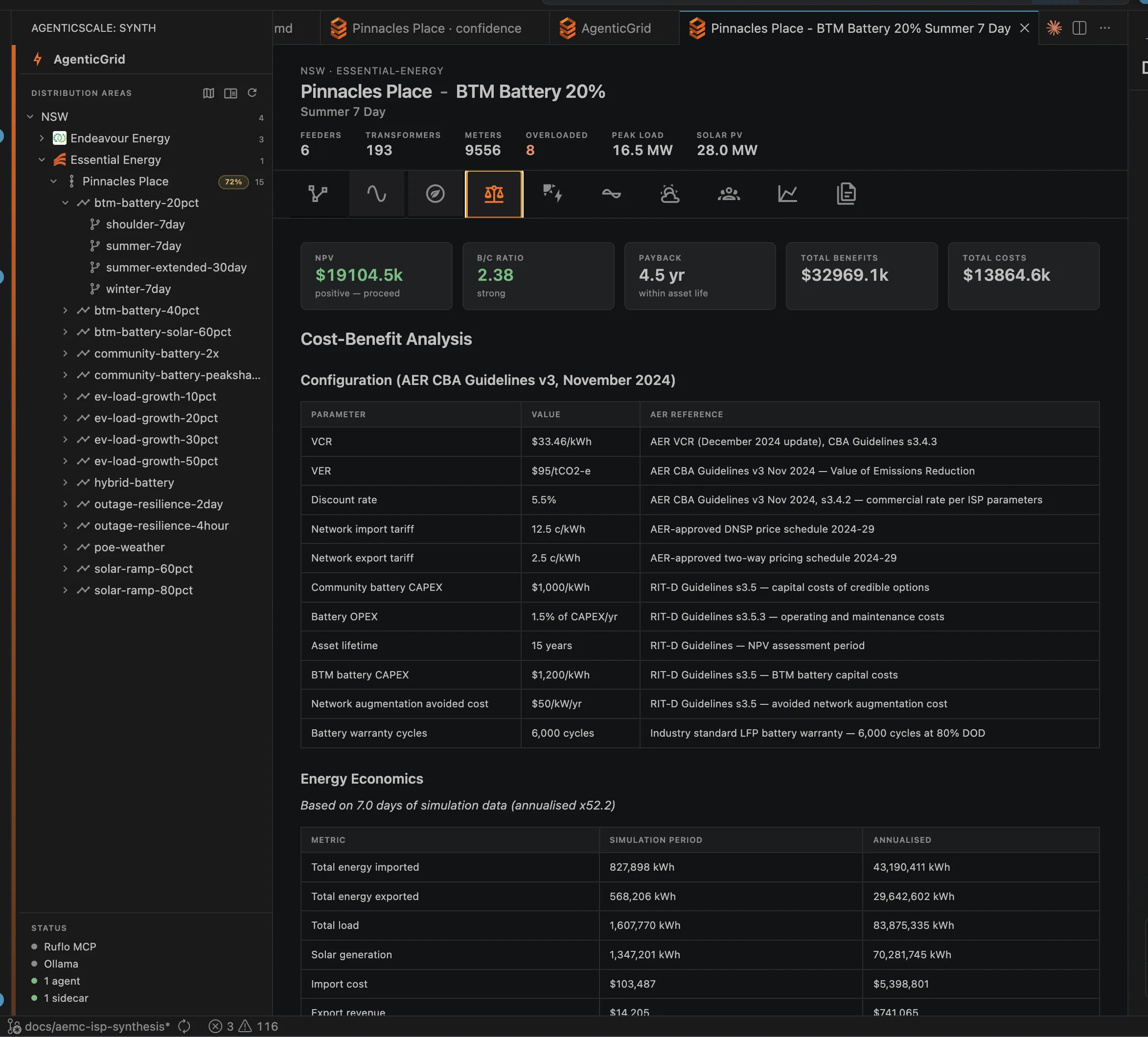
The defensible non-network response is hybrid storage
Behind-the-meter batteries combined with community-scale storage emerge as the strongest economically viable option that stays within hosting limits — under current AER inputs (VCR $33.46/kWh, emissions $95/tCO₂-e, 5.5% discount, 15-year asset life). Beyond a point the binding limit is the network, not the economics of the batteries themselves.
- Benefit-cost ratio
- 1.34
- NPV (15-yr)
- $9.08M
- AER inputs
- CBA Guidelines v3
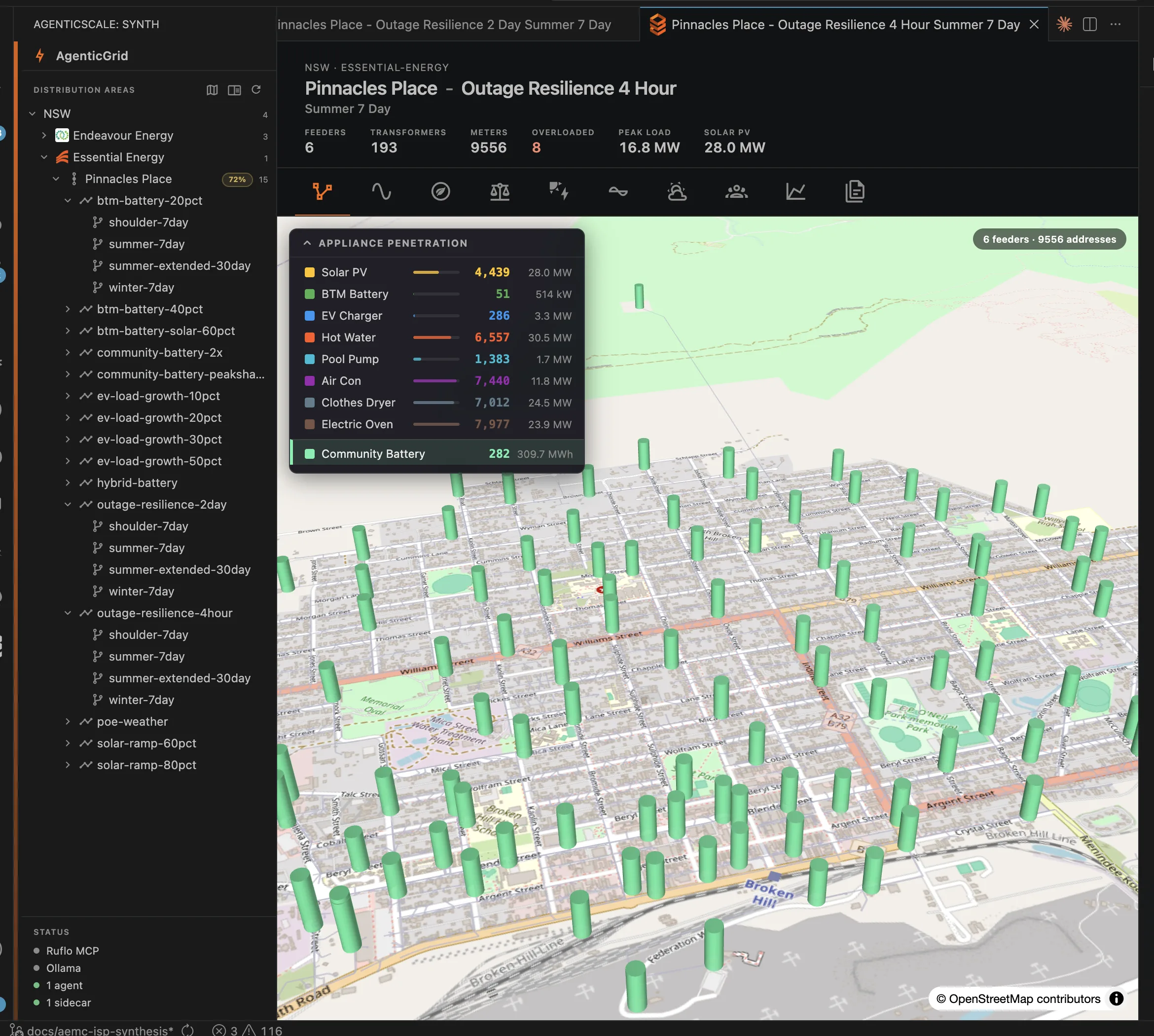
A regulator-relevant negative result
Full-coverage two-day outage resilience via community storage does not pass an AER cost-benefit test — and full-coverage four-hour is little better at BCR 0.20. The lesson for non-network-solution planning is precise: resilience storage must stack benefits (demand management, emissions, energy arbitrage) and target genuinely critical load, not deployed as blanket coverage. Proving what doesn't work transparently is itself transferable knowledge.
- Benefit-cost ratio
- 0.10
- NPV (15-yr)
- −$293M
- Outage modelled
- 2-day full coverage
What's in the box
Foreground IP — built during the program, ours to extend.
From the RACE for 2030 GridGuru Phase 2 program — each component originated in-project.
- 01Scenario-orchestration layer — the governed control plane for AI-driven modelling
- 02Per-address appliance-assignment engine — builds a bottom-up demand model of any area from public data
- 03Automated two-phase tuning pipeline — calibrates the model against measured load
- 04Cache-aware scenario persistence — reproducible, instantly retrievable results
- 05Easy-English + multilingual summarisation — board-grade, community-grade, regulator-grade
- 06Library of 12 parameterised demand-management scenarios (61 sub-scenarios for Broken Hill)
- 07AER-aligned cost-benefit module — VCR Dec 2024, CBA Guidelines v3, RIT-D framework
- 08Prompt-and-template library — shaped to distribution and transmission planning workflows
Runtime
Editor or browser — same React, same skills.
Engineers and analysts get the VS Code Extension; utilities get a per-tenant hosted web app. One codebase, two surfaces.
VS Code Extension
AgenticGrid lives as webviews under the ⚡ Synth Activity Bar, alongside the Modules launcher, scenario tree, and All Loops. Chat is VS Code’s own Claude Code panel.
- Local data + remote agents, in the editor you already use
- Open IDE chrome — drop into Python or Rust mid-question
- Same React, same skills, same backend as the web app
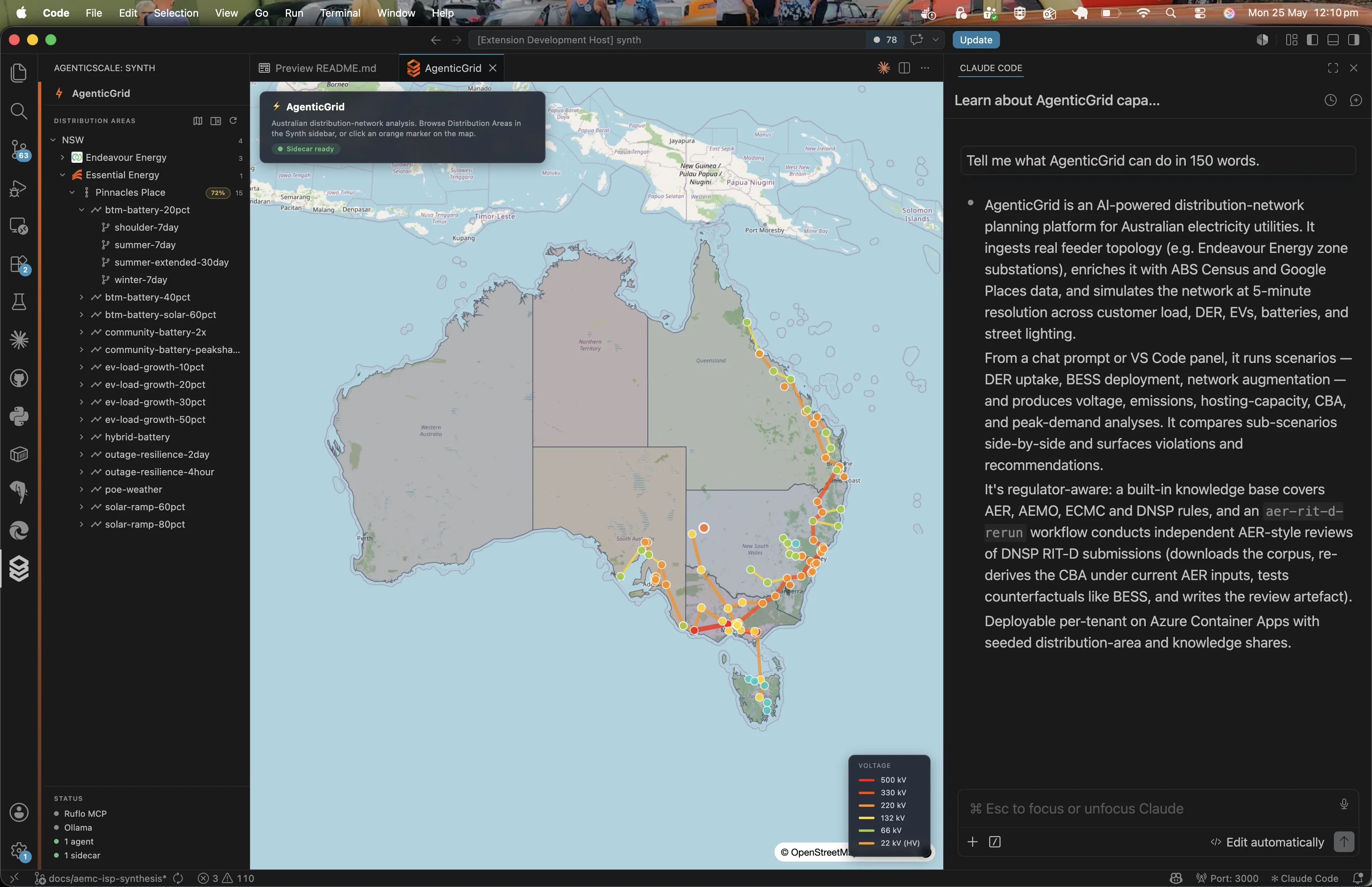
One React codebase, bundled by esbuild for both. Deploy a new tenant with the agenticgrid-deploy-webapp skill.